How “Clean” is That Portfolio?

An industry trend of the steadily increasing pace of regulation and the resulting volume of requirements is placing a great deal of pressure on an already stressed “creditor” compliance management systems.  Since the Consumer Financial Protection Bureau does not have direct jurisdiction over auto dealers, the CFPB have aggressively pursued and scrutinized indirect auto lenders and creditors in a number of calculational and compliance capacities.

This increased scrutiny on the indirect lending institutions intensifies the need for ensuring that assigned portfolios of motor vehicle sales transactions are “squeaky clean” from a compliant calculational and disclosure perspective.  This presents a unique challenge for many creditors that inherit/purchase bulk transactions that have been originated on a wide spectrum of systems with varying degrees of complexity and sophistication.  As a result, at Carleton, we have noticed that many major purchasing decisions for bulk portfolio purchases have in part depended on the “cleanliness” of the loans.

As the indirect lending industry itself adapts to meet consumer needs, the industry has drifted from the traditional equal payment “regular” transactions to more “exotic” transactional features being offered.  Consequently, the validation of the accuracy of the Truth in Lending Act APR disclosures, as well as state-specific usury maximums for many lending institutions for bulk purchases, is a very complicated, tedious, and manual process.  Validating one, no problem.  Validating thousands of loans is a different dynamic altogether.

At Carleton, we have the ability to take electronic data from a proposed bulk portfolio purchase and streamline the validation process.  No, every detail and potential risk factor cannot be easily identified and vetted. However, a creditor can confidently move forward with a portfolio purchase with less anxiety, having assurance that the potential portfolio purchase of bulk loans has accurate TILA APR disclosures with none exceeding the state-specific usury cap.

Bottom line…Making a compliant buying decision has never been easier with a little help from Carleton.

Credit Insurance on the Move!

Entering into 2016, three states published prima facie credit insurance rates will be changing.  Specifically, Colorado, Nebraska, and Virginia promulgate new prima facie rates for credit life and A&H.  These specific changes within a three-month period is a distinct departure from the recent historical trends of little movement in published prima facie rates.

In Virginia, credit life rates increased on January 1st, which also departs from the approximate 20-year trend of steady rate declines, while A&H rates decreased.

Colorado regulation, which contains a virtual labyrinth of rates for specifically designated coverage types, will also see the general credit life rates increase on February 1st while credit A&H rates remain unchanged.

The Nebraska Insurance Department Bulletin effectively reduces both credit life and A&H rates effective March 1st.

Carleton will closely monitor prima facie rate as this may be an active trend.

APRWin is Not Infallible!

APRWin, from the Office of the Comptroller of the Currency, is a mainstay in compliance circles.  It is a great tool, and, like nearly every field examiner in the Western Hemisphere, we use it nearly every day, right alongside our own Carleton APR validation tool. APRWin, however, is software, and all software makes trade-offs between being usable and being comprehensive; making best guesses as to the user’s intent in unusual cases. In the unusual case where payments are due on the last day of one month, but not the last day of every month, APRWin guesses wrong.

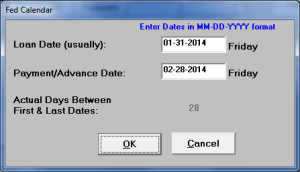
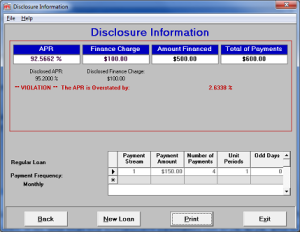
Consider a loan with $500.00 of Amount Financed as of July 31, 2014, with four payments of $150.00 each due monthly beginning August 28, 2014. Everyone would agree, and APRWin correctly determines, that there are twenty-eight days to the first payment. The APR (according to Appendix J’s actuarial method, which is all APRWin knows how to do) is correctly computed as 95.2080% (to four places).

Wouldn’t you think the APR would be exactly the same if you simply moved the entire loan, advance and four payments, six months earlier? APRWin doesn’t!

Fed Calendar

Okay? Not so fast. APRWin, in the absence of further information, decides that this is one full calendar month (well, it is for the first interval), and that the subsequent payments are also full calendar months back to the contract date.  With the rest of the payments scheduled on 3/28, 4/28, and 5/28, we know that isn’t so, but APRWin doesn’t.

Disclosure Information


Now that’s an overstatement that will get an examiner ex-“cited”! This can be somewhat ameliorated by entering the three remaining payments as a separate stream, but APRWin still miscalculates the time for the first payment and declares an “overstated” APR by 0.7428%.

The problem arises from exactly one shortfall: APRWin never asks for the scheduled payment date, and can only ask for the actual payment date. In Appendix J, section (b)(3)(iv) states, “If a series of payments (or advances) is scheduled for the last day of each month, months shall be measured from the last day of the given month to the last day of another month” (emphasis mine). With no way to ask for the scheduled payment date, it assumes that a payment on the last day of its month is scheduled for the last day of every month.  Your dad taught you what ‘assume’ makes out of you and me, right?

A savvy examiner will recognize this, and hand-calculate the Unit Periods and Odd Days rather than relying on APRWin to do so. A savvy lender, presented with an overstatement notice (and, since APRWin always calculates a longer time period, it always understates the true APR), will ask the examiner to do so when a loan’s payments are on the last day of some but not all months.  You can move this same loan to 3/31 with payments scheduled on the 30th of the next four months and see the same behavior, just not as dramatically.

The Actuarial Method – Beware the Compounding

During a recent training session for a group of newer employees  (fairly new by Carleton standards, since our average tenure is approximately 18 years of service), we began discussing the parameters integral to computing a loan payment.  I then asked:

“Ok, so now we agree on the parameters that will drive the payment calculation. If we’re a new company and I give you the task to program this into a viable computing routine, where do you go to find out how to compute a loan payment?  An extremely quiet 30-second impasse filled with blank stares and embarrassed smiles ensued, followed by a collective shrug of the shoulders “we’re really not sure”.

It is a true statement in this business of creating consumer lending calculations that there is no granular level standard textbook for computing loan payments.  Yes, you can start with the PV of an annuity formula.  But that is incredibly generic and limited for today’s lending industry and its ever-expanding “exotic financing” outlook.  For instance, you can’t compute daily simple interest by formula. It is the broadening and refining of that basic equation that is the key to the payment computing kingdom.

So, it’s no wonder that we regularly see loan transactions from systems (LOS and DMS) that incorporate payment calculation routines where interest accrues by the “actuarial method”.

In this context, the statutory definition for the term “actuarial method” is usually something like “as defined by the Federal Reserve Board in Regulation Z 12 C.F.R. Sec. 266 that implements the Truth in Lending Act.”

Since the Truth in Lending Act requires an APR to be computed for nearly every consumer credit transaction, what safer way to build a compliant payment computing routine than to manipulate the Appendix J algorithm for computing a Reg. Z APR, from finding a rate to finding a payment?  “If I just follow that same template, how can I go wrong?”  Or so the thought process goes.

One major stumbling block to that solution is that the Appendix J algorithm incorporates the inherent compounding of interest.  Nowhere in the definitions, variables, or other explanations is that fact stated, but it’s there in the math.

Given that the compounding of interest is generally held to be against public policy in many jurisdictions and the fact that compounding increases the effective yield of the transaction, it can be a precarious practice at best.  Very often, compounding must be both expressly allowed by statute and clearly agreed to by the parties involved.

I often wonder what percentage of programmers, loan officers, and compliance officers are even aware it’s there, inherent in the math of the method itself anytime a first interval is longer than a regular period.

Even though a few states, like Louisiana, expressly allow compounding by authorizing the actuarial method of interest accrual in their statutes, the real question for lenders should be “how well will this play in front of Judge Wapner at six o’clock?”

One phrase regarding compliance that I have come to embrace over the years is “The Greatest Risk come from those things that have no history of problems”.

Computing an APR with the new Mortgage Payment Disclosures

Had an interesting phone message from a colleague attending a Mortgage Bankers Conference yesterday.  It went something like this:

“Just got out of a really interesting session.  A great deal of debate and discussion on being able to validate the TILA APR at mortgage closing with the new mortgage disclosures.  Each of the panel members computed a different rate for the same loan. The animated discussion was about which one was right.  There is great concern that at closing, you have to gather documents from multiple parties and pull information together from these various documents.  One mistake and you have a situation.”

Sometimes, it takes a while for certain chickens to come home to roost.

Back in the fall of 2010, when the interim rule about what, at Carleton, we call the “MDIA Payment Disclosures” proposal was published, it was clear that one of the deficiencies of the attempt to overhaul mortgage disclosures was that the contract itself did not display the actual payment schedule that other TILA disclosures were derived from.

In short, there isn’t the proper information on the contract disclosure to compute/validate the TILA APR.

Since our focus is on the calculations and disclosures, that fact was a glaring drawback in our view.  We opined exactly this issue to the Federal Reserve Board of Governors, they actually promulgated the original interim rule, during the industry comment period.

At the time in exploring this issue with regulators at both the national and state level, we got pretty much the same response, “Well, examiners have to look at the HUD-1 anyway, they can get the payment information from there”.

After 29 years in the Carleton Research Department, I can’t even tell you how many times I have worked with auditors, compliance officers, attorneys, and examiners who believed an APR value was incorrect only to realize the issue was with inaccurate data entered into the APR check program they were using. This when all the payment information required was still in the Fedbox on the contract.

Now the expectation is to pull critical information from other documents?  Have you ever noticed how many numbers reside on a completed HUD-1 form?

It just seems that the new disclosures have opened a huge door on the opportunity for inaccuracies ranging from simple lapses to egregious errors on the part of auditors who now have to play detective with an assortment of documents.

More information isn’t always better information.

*If you would like to view Carleton’s official comment letter to the FRB concerning the MDIA Mortgage Payment Disclosures, click on the link below:

Carleton’s Official Comment Letter

Is Calculation Validation Included in Your Compliance Program?

Often, we fall prey to not being able to see the forest because of the trees.  The details overwhelm us and we miss the proverbial big picture.  When it comes to the compliance of your credit calculations, I’m afraid these days the opposite may be taking place.

The nuances and parameters driving the calculations that create credit disclosures reside at such an esoteric, granular level that a long list of “900 lb. Gorillas” is currently over- crowding the room — disparate impact, fair lending, ATR, QM, UDAAP, HMDA data — none of which are focused on the integrity of how you calculate your traditional disclosures.

The consumer credit mathematics is often overlooked and, yes, taken for granted that it’s “just math” and influenced by the “we just need to find someone with an advanced mathematics degree” mindset.

But if you have ever spent much time trying to unravel your institution’s settings, parameters, interest accrual methods, rounding options etc., you know the consumer credit math is its own animal when compared to mainstream, everyday arithmetic.

With the expansion of regulatory requirements, it is paramount that all facets of a lender’s operation “cross foot and balance,” so to speak. We are calling that process “alignment.”

Alignment means the same methods are used throughout the life of the transaction.  The narrative description in the lending agreement states that the lender will compute and accrue charges according to certain rules and parameters. The disclosure numbers populating the agreement are the product of employing those rules and parameters. The back-end servicing calculations actually collect the charge in the exact same manner.  It all matches.

Sounds simple, right?

You would be surprised how often we see lending documents state that “charges will be computed on a 365-day year” in the promise to pay section, yet the numbers populating the form are generic, periodic, 30/360, HP 12C type calculations.

Those generic calculations are much simpler to program and compute and, most likely, have been embedded in the loan origination system for decades.  We’ve got an incongruity right off the bat and we haven’t even gotten to the servicing calculations yet.

There is a train of thought that “it all comes out in the wash” with the interest-bearing, a.k.a. “simple interest”, transactions that dominate today’s credit market.  “The consumer isn’t going to make all of their payments exactly on due dates anyway, so what’s the big deal about the regular payment?”

Well, besides the advent of debit/e-check/ACH payment proliferation rendering the previous adage practically unserviceable, there is the battle to define, determine, and evade the newly created CFPB two-headed specter of “deceptive” and “abusive”.

What better defense than all phases of your operation accurately and consistently portraying the contractual obligation between the lender and the borrower?

It might be worthwhile to step out of the dense compliance forest for just a moment and take a close look at the tree that houses your system calculation engine.

The APR: Semi-monthly Complications

There has been a marked increase over the past couple of years in credit plans being tailored to the payroll frequencies of respective borrowers and retail buyers.  Creditors like the security of scheduling payments in accordance with how their customers get paid by their employers.

Sounds simple enough, but like nearly everything surrounding consumer credit calculations, some of these options can be a bit tricky as far as producing accurate Truth in Lending disclosures.  Particularly, the annual percentage rate.

Take, for instance, borrowers who get paid only once a month.  Typically, that event occurs on the last day of every month. Appendix J of Regulation Z has particular language dealing with payments scheduled on the last day of each month.  Like many other scenarios, the techniques used to enter and exit the month of February generally take special code to account for the fact that the month on either side of February contains 31 calendar days while February itself has only 28, or perhaps 29 if it’s a leap year.

Even more perplexing, and nearly universally misunderstood, are the rules for computing the APR when the repayment period is “semi-monthly,” constituting 24 payments in each calendar year.  It doesn’t take an advanced math degree to figure that 2 payments per month during a year that contains 365 calendar days is going to create some unique time periods.

Too often, we see systems encounter the pitfall of declaring a semi-monthly period to be 15 days long.  Part of that is fueled by the language in Appendix J for determining the fractional unit period in a semi-monthly scenario by dividing by 15.  That value is evident, so programmers run with it.

However, remember that the Appendix J unit period concept is the “common period that occurs most often”.

If a computing routine declares that a semi-month period is every 15 days, then the period occurring most frequently, and hence the unit period for the APR, is exactly that: 15 days.  And…that is not a “semi-month”.  24 payments per year, every 15 days, still leaves 5 calendar days unaccounted for.

A 15 day unit period will produce a distinct APR value when compared to one using a semi-month for the same transaction data.

It’s an easy trap to fall into and we see the results from originating systems on a regular basis.

Preparing for the 2014 HOEPA Regulations

We’ve spent the last couple of months putting the finishing touches on revisions to the Carleton “HOEPA” module.  Like any software update that deals with regulations, the bulk of the changes were fairly straightforward.  It is the nuances “around the edges” that always make life a bit more interesting.

For a company like Carleton that specializes in consumer credit math, the big ticket items were the structural changes to the “APR Trigger” and “Points and Fee Trigger”.  Those two items represent the anchors of our role in the HOEPA determination process.

The  APR Trigger now features lower percentages representing the threshold.  The 8%/10% values currently in place will be replaced by 6.5%/8.5%.  The other major change is that the rate used for evaluation will become the Average Prime Offer Rate, as published on the FFIEC website.

Those were obvious material revisions to the current regulation.  A more subtle change is that the “APR”, compared to the APOR rates, is no longer the computed and disclosed Truth in Lending Act APR for the transaction.  Instead, the interest rate is now used for comparison.

Yet the label is still referred to as “APR.”  We fight the battle constantly to use precise and accurate labels to enhance clear communication.  Then, the regulation itself promotes an “APR that is not an APR”.  Ya gotta love administrators.

It appears that one of the goals of the APR Trigger restructuring is to bring the HOEPA threshold process more in line with similar ones for the HMDA rate spread and HPML determinations.

One of the nuances affected, more or less by implication, is that by adopting the APOR standard, the determination of a “comparable transaction” changes for adjustable-rate loans.  The comparable transaction is no longer based on the life of the loan.

The Points and Fees Trigger has been revised and now has a tiered rate structure with the percentage being 5% for loans under $20,000 and 8% for loans of $20,000 or more.  There is also a new “floor” amount of $1,000 associated with the 8% fee percentage.

It looks like January 2014 will be a busy and interesting month as a number of new regulations go into effect.

Maximum Finance Charges…It’s Not Just the Rate

The regulatory climate is about as uncertain and volatile as I have seen it in my 28-plus years at Carleton.  Of course, the big dog in the room is the CFPB administering the Dodd-Frank Act provisions.  It is a task of such enormity that it’s obviously being done piecemeal over a several-year period and leaving most of us with a sense of impending, “I wonder what’s next.”

We have also seen a flurry of activity on the state level over the last several months.  Much of it actually impacting charges, disclosures, and calculations.  That is something we haven’t seen much of over the last 10 years or so.

The crush of dealing with some new type of regulation is overwhelming at times as lenders face new requirements from varying directions.

Like many who serve the consumer credit industry, we have been counseling our clients to “get ready” and “be prepared” for what’s coming by taking stock of their current compliance program.  That, of course, includes the often overlooked area of credit calculations and disclosures.

As we field more compliance-related questions, I am always a bit surprised that the “Maximum APR” viewpoint is still so prevalent in the industry.

If it were only that easy!  The fact is, most consumer lending statutes regulate the dollar amount of the charge, whether it’s referred to as interest, finance charge, or time-price differential.  The dollar charge is created by the application of the published maximum rate to the outstanding balances of the transaction.

It’s important to note that a TILA APR computed by the actuarial method is going to use the charge accrual calendar prescribed by Appendix J to Regulation Z, often referred to as the “Federal Calendar” (Fed Cal).

The calendar prescribed by a specific state statutory provision, more than likely, does not use the Fed Cal for determining the maximum charge.  A few states do use the definition of  “actuarial method” in describing how state charges are to be computed.  However, in most cases, they do not always comprehend the detailed level specification that the actuarial method contains inherent compounding of interest.

So, if the state-prescribed calendar for maximum charge in the statute differs from the one used to compute the TILA APR, the APR is not an accurate barometer of compliance with a state statutory provision on the maximum charge allowed.

Also, the TILA APR is generally a two or three place value, it has to fit in the Fedbox allotted space, which means it is a rounded value.  Quite often, the TILA APR, rounded for the purpose of display, can provide a false sense of security or produce a premature overcharge warning for a specific set of loan data.

It is possible for a disclosed 21% TILA APR to produce a state-sanctioned finance charge that exceeds the prescribed 21% published statutory maximum rate and thus represents a violation.  It’s all in the details.

MOB Credit Insurance and the CFPB

It’s been an active month for regulation, to say the least.  A minor deluge of state-based July 1st law changes mixed with the CFPB’s upswing in both proposed and final regulations has made for an awful lot of reading, analysis, and retrofitting of existing programs.

The CFPB saga regarding the attempt to implement the Dodd-Frank prohibition on single premium credit insurance/deb cancellation products with real estate transactions has taken its latest turn with their clarification proposal on June 24th.  A good deal of that appears to be in response to the industry’s requests for a clearer meaning of the “calculated paid in full on a monthly basis” clause in the original CFPB proposal.

The June 24th proposal appears to center around two broad definitions; that of ‘calculated on a monthly basis’ and the definition of ‘financed’.  Make no mistake, there are other issues addressed, along with an almost endless list of granular subplots, but to an entity like Carleton, where the credit math is a first priority, these two points dominate the initial discussion.

One additional point of interest where it appears the effect of the mathematics involved is not clearly understood is in the CFPB expectation that credit transactions with traditional MOB insurance (or monthly debt cancellation) should create the same interest charge as a comparable transaction with no insurance.

From an “outside looking in” perspective, that doesn’t seem to be an unreasonable presumption.

The fact is, though, that the traditional objective of supplying an equal monthly payment to the consumer, and the math required in that process, renders the ideological goal of identical interest charges an impractical impossibility.

The equal monthly payment containing MOB insurance is made of three parts; computed insurance premium, accrued interest, and principal reduction.

The insurance portion is found by multiplying a rate times the outstanding loan balance each month, so that portion is variable.

The remaining principal and interest components must also be variable to arrive at an equal sum each month.

The kicker is that once all those variable pieces of the payment are rounded to dollar and cent values in order to make the payment “collectible”, the dynamics of the transaction change.  Merely the monthly insurance portion produced by multiplying the rate times the outstanding loan balance each month is going to be a value like $13.125812964… and on to 32 decimal places.

Rounding the insurance piece to $13.13 produces one effect, rounding to $13.12 another and the effect becomes cumulative throughout the life of the transaction.

That rounding effect generally does slow the liquidation of principal a bit and produces a slightly higher total interest charge. Whether that slowdown in principal reduction is ‘significant’ is probably in the eye of the beholder, but it’s simply the nature of the beast.

So, the expectation of “identical interest charges” and the idea that credit insurance premiums are calculated on a monthly basis “if they are determined mathematically by multiplying a rate by the actual monthly outstanding balance” seem to work at a bit of a cross purpose.