
Military APR Requirements Are Right Around the Corner…Are You Ready?

FOR IMMEDIATE RELEASE

For more information contact:
Carleton Sales Team
574.243.6040 option #3
sales@carletoninc.com


As October 3rd approaches, the Carleton team wants to ensure that our partners are equipped to comply with the new Military Lending Act requirements.

The maximum 36% Military Annual Percentage Rate (MAPR) requirement has been in effect since January 2007, but only applied to payday, vehicle title, and refund anticipation loan products.  Effective October 3, 2016, nearly all loan products provided by lenders extending credit to active military personnel must comply with the maximum 36% MAPR.

“Military Interest” included the finance charge as defined in TIL Reg. Z, as well as the following fees and premiums items:

  • Application fees (new requirement)
  • Points, origination fees, participation fees – all fees in the TILA Reg. Z finance charge
  • Any premium or fee for credit insurance.
  • Any debt protection charges/fees (cancellation and suspension)
  • Any credit-related ancillary product sold in conjunction with the transaction

The CarletonCalcs® Origination Module has been updated to define which fees will be included or excluded for purposes of calculating the Military Interest and MAPR.  This update to CarletonCalcs® will enable our partners’ lenders to individually define which fees will be treated as Military Interest for each individual loan product.

If you have any questions regarding this release and how Carleton can help you stay compliant with the MAPR requirements, contact your Carleton sales or support representatives at (800)433-0090.

About Carleton, Inc.

Carleton is the country’s leading provider of financial calculation software, loan origination compliance support, and document generation software. With over 55 years of experience, our ongoing expertise and industry knowledge reaffirms why Carleton is a trusted partner. Founded in conjunction with the Truth In Lending Act, Carleton provides expert compliance support with continuous accuracy in all our calculations and disclosures at a state and federal level. To learn more about Carleton’s lending solutions, contact our sales team at sales@carletoninc.com or 574-243-6040 option #3.

 

It’s Not Just the Rate…

At Carleton, we spend a lot of time and focus on helping our partner lenders stay compliant in the area of the maximum state finance charge that is allowed by a statute or regulation.  Consistent with our expertise, once we drill down to the granular detail, the compliant calculations are not always what they seem.

Regarding the financial term usury, in our opinion usury is not always the most technically correct term for statutory maximum charges, it is however the financial term used most frequently in the industry.  The usury calculation focus by most lenders is almost always on the rate itself.  We have frequent discussions that usury is not merely the rate itself but the application of that published maximum rate that is integral to being compliant.

The passage of HB 1511 in Mississippi recently is a perfect example.  The new Consumer Alternative Installment Loan Act prescribes a maximum rate of 59%.  There is also a provision making an allowance for a daily interest accrual calendar, aka 365/365, that recognizes the current trend toward “simple interest” interest-bearing loans and away from traditional pre-computed transactions.

However, like other provisions in the Mississippi Code, it is clear that the maximum 59% will be measured by the “actuarial method”.  Since that label is defined in the small loan regulations as holding the same meaning as in Regulation Z that implements the Federal Truth in Lending Act, which means the 59% will be a TILA APR type number.  The actuarial method requires the “Federal Calendar,” which is a monthly accrual calendar and recognizes each month as 1/12 of a year.

The effect is what we see frequently in today’s consumer finance industry.  Applying a nominal contract rate on a daily basis yields a different value when it is measured on a monthly basis.  In the case of the Mississippi bill, applying a 59% contract rate using a 365/365 calendar can yield an actuarial method APR as high as 59.18%.

That means lenders will have to reduce their in-going contract rate in order not to violate the 59% maximum provision.  That fact is not evident unless you live in the “weeds” of the consumer finance mathematics as we do at Carleton.  In most states, it is the state “finance charge” as a dollar amount that is regulated and not merely the published nominal rate.  That is one reason “table lookup” is not always a safe and efficient method of testing for compliance.

Military APR Changes on the Horizon

Carleton announces the July release of the latest CarletonCalcs® Origination module to support the changes identified in the 2015 amendment of the Military Lending Act (MLA) effective October 3, 2016. Previously, the regulation was limited to payday, vehicle title, and refund anticipation loans, but as of October 3, 2016 will affect nearly all lenders extending credit to active military personnel.   The purchase of motor vehicles and 1st lien purchase mortgages have been excluded.

Credit insurance and fees for debt cancellation or debt suspension fees are included in the calculation of the MAPR in accordance with the John Warner National Defense Act in 2007.  The major change from the DOD to the new regulation is that “bona fide” fees may now be excluded from the MAPR.  The Act defines interest for the purposes of complying to include:

  • Application fees* (new requirement)
  • Points, origination fees, participation fees – all fees in the TILA finance charge
  • Single premium credit insurance premiums
  • Single amount debt protection charges/fees (cancellation and suspension)
  • Any credit-related ancillary product sold in conjunction with the transaction

The Military APR cannot exceed 36%.

Carleton has added the ability to the CarletonCalcs® Origination module to customize which fees will be included or excluded to allow lenders to customize which fee will affect the MAPR to meet their individual needs.

If you have any questions regarding this release and how Carleton can help you stay compliant with the MLA, contact your Carleton sales or support representatives at (800)433-0090.

How “Clean” is That Portfolio?

An industry trend of the steadily increasing pace of regulation and the resulting volume of requirements is placing a great deal of pressure on an already stressed “creditor” compliance management systems.  Since the Consumer Financial Protection Bureau does not have direct jurisdiction over auto dealers, the CFPB have aggressively pursued and scrutinized indirect auto lenders and creditors in a number of calculational and compliance capacities.

This increased scrutiny on the indirect lending institutions intensifies the need for ensuring that assigned portfolios of motor vehicle sales transactions are “squeaky clean” from a compliant calculational and disclosure perspective.  This presents a unique challenge for many creditors that inherit/purchase bulk transactions that have been originated on a wide spectrum of systems with varying degrees of complexity and sophistication.  As a result, at Carleton, we have noticed that many major purchasing decisions for bulk portfolio purchases have in part depended on the “cleanliness” of the loans.

As the indirect lending industry itself adapts to meet consumer needs, the industry has drifted from the traditional equal payment “regular” transactions to more “exotic” transactional features being offered.  Consequently, the validation of the accuracy of the Truth in Lending Act APR disclosures, as well as state-specific usury maximums for many lending institutions for bulk purchases, is a very complicated, tedious, and manual process.  Validating one, no problem.  Validating thousands of loans is a different dynamic altogether.

At Carleton, we have the ability to take electronic data from a proposed bulk portfolio purchase and streamline the validation process.  No, every detail and potential risk factor cannot be easily identified and vetted. However, a creditor can confidently move forward with a portfolio purchase with less anxiety, having assurance that the potential portfolio purchase of bulk loans has accurate TILA APR disclosures with none exceeding the state-specific usury cap.

Bottom line…Making a compliant buying decision has never been easier with a little help from Carleton.

Carleton Introduces Next Generation Financial Calculations Module: OriginationPlus

FOR IMMEDIATE RELEASE

For more information contact:
Carleton Sales Team
574.243.6040 option #3
sales@carletoninc.com


The OriginationPlus module leverages the CarletonCalcs® Origination and Compliance modules together in a single API call to compute transactions that are compliant from internal institutional thresholds as well as federal, state usury requirements.

OriginationPlus allows Carleton’s clients to maximize their profit by computing transactions at or near internal and state maximum allowable rates.  If a specific transaction exceeds the state usury or internal maximum policy interest or finance charges, Carleton’s Origination Plus engine will reduce the interest rate automatically, consistent with an amount set by institutional guidelines, until the transaction passes the compliance validation.

This solution allows Carleton’s partners to streamline the compliant calculation process by utilizing one API call versus computing multiple transactions and validating compliance separately.

For more information on OriginationPlus, please contact your Carleton Representative.


About Carleton, Inc.

Carleton is the country’s leading provider of financial calculation software, loan origination compliance support, and document generation software. With over 55 years of experience, our ongoing expertise and industry knowledge reaffirms why Carleton is a trusted partner. Founded in conjunction with the Truth In Lending Act, Carleton provides expert compliance support with continuous accuracy in all our calculations and disclosures at a state and federal level. To learn more about Carleton’s lending solutions, contact our sales team at sales@carletoninc.com or 574-243-6040 option #3.
Carleton Introduces Next Generation of Software for Lending and Auto Industries

FOR IMMEDIATE RELEASE

For more information contact:
Carleton Sales Team
574.243.6040 option #3
sales@carletoninc.com

Suite of Software and Auditing Services for Generating Compliant Loan Calculations and Documents

South Bend, IN (January 29, 2016): Carleton Inc., a leading provider of compliant loan calculation and document generation software solutions, has announced the next generation suite of software, Carleton Lending Solutions, including CarletonCalcs®, CarletonDocs®, CarletonAccess®, and CarletonAudit®.

Carleton Lending Solutions incorporates the latest upgrades to the firm’s LoanSmart Solutions that have been adopted by major lending software providers for over 20 years.  These lending solutions represent Carleton’s commitment to delivering software that meets Consumer Financial Protection Bureau (CFPB) third-party vendor compliance recommendations and consumer privacy and security requirements.

In 1996, Carleton introduced LoanSmart Lending Solutions that included web applications and software modules that easily integrated with loan origination systems to perform compliant loan calculations and the seamless generation of lending documents.  Twenty years later, Carleton’s LoanSmart solutions are used by over 125 lending software providers to meet the compliance requirements of their clients.

“Carleton’s ability to adapt our software and support to the ongoing changes in technology, lending, and compliance has made us the preferred partner of loan origination software providers who recognize the importance of having long-term compliance support for their lenders,” commented Pat Ruszkowski, president and CEO of Carleton. “We renamed our next-generation lending solutions using the Carleton name to reflect our company’s 45+ year compliance leadership in the lending industry.  Our compliance support and active dialogue with the federal and state regulators to assist our clients in this complex and highly regulated lending environment is built into all our lending solutions.” Carleton Lending Solutions’ suite of software supports all types of lending activities, including mortgage, consumer, auto lending and leasing, payday lending, and business lending.


About Carleton, Inc.

Carleton is the leading provider of compliant and easy-to-use lending and leasing calculation software and document preparation software serving the lending and auto industry. Founded on compliance expertise at a federal and state level in 1969, the company’s client list has grown to include most of the major lenders, credit insurance companies, and loan origination software providers in the United States. To learn more about Carleton’s lending solutions, contact our sales team at sales@carletoninc.com or 574-243-6040 option #3.
Credit Insurance on the Move!

Entering into 2016, three states published prima facie credit insurance rates will be changing.  Specifically, Colorado, Nebraska, and Virginia promulgate new prima facie rates for credit life and A&H.  These specific changes within a three-month period is a distinct departure from the recent historical trends of little movement in published prima facie rates.

In Virginia, credit life rates increased on January 1st, which also departs from the approximate 20-year trend of steady rate declines, while A&H rates decreased.

Colorado regulation, which contains a virtual labyrinth of rates for specifically designated coverage types, will also see the general credit life rates increase on February 1st while credit A&H rates remain unchanged.

The Nebraska Insurance Department Bulletin effectively reduces both credit life and A&H rates effective March 1st.

Carleton will closely monitor prima facie rate as this may be an active trend.

IMM, Carleton Integrate Technologies to Support TRID Compliance

FOR IMMEDIATE RELEASE

For more information contact:
Carleton Sales Team
574.243.6040 option #3
sales@carletoninc.com


Partnership Helps Financial Institutions Automate the Lending Process, Meet TRID Requirements

LINDEN, NJ (August 4, 2015): IMM, a pioneer of integrated eSignature, workflow, and document solutions for the modern business enterprise, and Carleton, a provider of compliant consumer lending calculations and document generation services, have forged a partnership enabling loan documents generated through Carleton’s CarletonDocs® to be eSigned with IMM’s eSignature solution, TotaleAtlas.

This partnership allows banks and credit unions to deliver convenient, flexible eSignature options for consumers to complete loan documents. The integrated solutions also support the new TILA RESPA Integrated Disclosure (TRID) guidelines from the Consumer Financial Protection Bureau (CFPB), which is currently scheduled to become effective on October 3, 2015.

“By integrating our CarletonDocs® solution with IMM’s TotaleAtlas, a financial institution’s customers can eSign loan documents either in-person at a branch or remotely from any location or device,” said Pat Ruszkowski, president of Carleton. “We saw an ideal opportunity with IMM to unite our solutions and empower our financial institution customers to improve productivity and the customer experience through transaction automation.  Partnering with IMM provides our customers with a proven and compliant eSignature solution.”

CarletonDocs® support the generation of all the lending documents related to each individual loan product offered by the lending institutions.  Carleton supports the lender’s custom documents, the documents provided by all major third-party document providers, as well as the dynamic generation of disclosure documents based on the attributes for each loan, ensuring lenders meet prescribed TRID requirements.  Now, prepared lending documents can be seamlessly delivered to IMM’s TotaleAtlas, creating an expedient eSignature process and further promoting compliance through an enhanced TotaleAtlas signing event audit file and rules-based eSignature management.

“Even with the TRID deadline extension, banks and credit unions are still under enormous pressure to implement the automation necessary to comply,” said John Levy, IMM executive vice president and ESRA (Electronic Signature & Records Association) board member. “Carleton and IMM have two products that complement one another, and it became a natural fit to help more financial institutions leverage eSignatures and automate their processes to meet the quickly approaching requirements and regulations. Now, Carleton’s financial institution customers can fully manage the signing event while providing consumers an intuitive, convenient experience.”


About Carleton, Inc.

Carleton Inc., based in South Bend, IN, is the leading provider of financial lending and leasing calculation software, compliance support, and document generation software. Founded in conjunction with the Truth-In-Lending Act in the late 1960’s, their client list has grown to include many of the major automotive finance companies and lenders, automotive lending software providers, loan origination software providers, and credit insurance companies in the United States. To learn more about Carleton’s lending solutions, contact our sales team at sales@carletoninc.com or 574-243-6040 option #3.


About IMM

Based in Linden, N.J., IMM develops and delivers innovative technology solutions that enable financial institutions to electronically streamline their business operations and processing environments. With a strong and secure legacy of serving more than 650 banks and credit unions with solutions for eSignature capture, business process (workflow) automation, and document presentment, IMM continues to create advanced software applications that promote clients’ sustainability while dramatically increasing productivity and operational efficiencies. The company is a longtime advocate of eSignature adoption and education, active in ESRA to advance the public’s understanding of issues surrounding the use of electronic signatures and records. For more information, visit www.immonline.com

Carleton Introduces CarletonDocs® Solutions for New Integrated TILA/RESPA Disclosure Requirements

FOR IMMEDIATE RELEASE

For more information contact:
Carleton Sales Team
574.243.6040 option #3
sales@carletoninc.com


South Bend, IN (November 11, 2014): Carleton, the leading provider of compliant consumer lending calculations and document generation services to financial lending institutions nationwide, has enhanced their CarletonDocs® and CarletonCalcs® software to meet the new Consumer Financial Protection Bureau (CFPB) mandated disclosure requirements for consumer mortgage loans. The Integrated Disclosure rule requirements are part of the Truth in Lending Act (TILA) and Real Estate Settlement Procedures Act (RESPA) that go into effect on August 1, 2015.

The TILA/RESPA Integrated Disclosure regulation requires the Loan Estimate (formerly “Good Faith Estimate” and “Early TILA Disclosures”) and Closing Disclosure (formerly “HUD-1 Settlement Statement”) documents to be based on the unique features and attributes specific to each individual real estate secured loan. Additional calculated disclosure data will be required to produce the disclosure documents. Over 1,000 different disclosure formats can be required as prescribed by the regulation, depending on the specific characteristics of the selected loan product.

Carleton’s solution dynamically generates the disclosure documents based on the attributes for each individual loan, ensuring the lender meets each prescribed requirement of the new regulation.  “The dynamic generation of documents provided in CarletonDocs® enables an LOS provider to support the upcoming TILA/RESPA regulations as well as any future dynamic requirements by the regulators and lenders,” said Deb Grounds, vice president of software services at Carleton.

New software enhancements include all the additional disclosure calculations, alphabetic sorting of fee fields, and the dynamic composing of the fields, formats, and text in the generation of the disclosure documents.   Security and version control enhancements have also been added to ensure accurate generation of compliant disclosure documents.  Carleton’s solution can be easily integrated and requires no changes to the document generation services already used within the LOS.

“In today’s lending environment, lenders will change their loan products and features to stay competitive,” says Pat Ruszkowski, president and CEO of Carleton.  “Under the new regulations, lenders will need to make sure that the format of the disclosure documents remains in compliance when changes are made to their loan products.  Carleton’s CarletonDocs® solution provides the “peace of mind” that generated disclosure documents always meet the prescribed disclosure rules.”


About Carleton, Inc.

Carleton is the country’s leading provider of financial calculation software, loan origination compliance support, and document generation software. With over 55 years of experience, our ongoing expertise and industry knowledge reaffirms why Carleton is a trusted partner. Founded in conjunction with the Truth In Lending Act, Carleton provides expert compliance support with continuous accuracy in all our calculations and disclosures at a state and federal level. To learn more about Carleton’s lending solutions, contact our sales team at sales@carletoninc.com or 574-243-6040 option #3.

APRWin is Not Infallible!

APRWin, from the Office of the Comptroller of the Currency, is a mainstay in compliance circles.  It is a great tool, and, like nearly every field examiner in the Western Hemisphere, we use it nearly every day, right alongside our own Carleton APR validation tool. APRWin, however, is software, and all software makes trade-offs between being usable and being comprehensive; making best guesses as to the user’s intent in unusual cases. In the unusual case where payments are due on the last day of one month, but not the last day of every month, APRWin guesses wrong.

Consider a loan with $500.00 of Amount Financed as of July 31, 2014, with four payments of $150.00 each due monthly beginning August 28, 2014. Everyone would agree, and APRWin correctly determines, that there are twenty-eight days to the first payment. The APR (according to Appendix J’s actuarial method, which is all APRWin knows how to do) is correctly computed as 95.2080% (to four places).

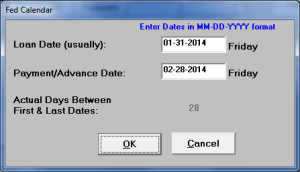
Wouldn’t you think the APR would be exactly the same if you simply moved the entire loan, advance and four payments, six months earlier? APRWin doesn’t!

Fed Calendar

Okay? Not so fast. APRWin, in the absence of further information, decides that this is one full calendar month (well, it is for the first interval), and that the subsequent payments are also full calendar months back to the contract date.  With the rest of the payments scheduled on 3/28, 4/28, and 5/28, we know that isn’t so, but APRWin doesn’t.

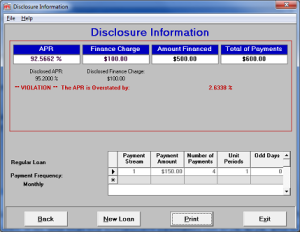
Disclosure Information


Now that’s an overstatement that will get an examiner ex-“cited”! This can be somewhat ameliorated by entering the three remaining payments as a separate stream, but APRWin still miscalculates the time for the first payment and declares an “overstated” APR by 0.7428%.

The problem arises from exactly one shortfall: APRWin never asks for the scheduled payment date, and can only ask for the actual payment date. In Appendix J, section (b)(3)(iv) states, “If a series of payments (or advances) is scheduled for the last day of each month, months shall be measured from the last day of the given month to the last day of another month” (emphasis mine). With no way to ask for the scheduled payment date, it assumes that a payment on the last day of its month is scheduled for the last day of every month.  Your dad taught you what ‘assume’ makes out of you and me, right?

A savvy examiner will recognize this, and hand-calculate the Unit Periods and Odd Days rather than relying on APRWin to do so. A savvy lender, presented with an overstatement notice (and, since APRWin always calculates a longer time period, it always understates the true APR), will ask the examiner to do so when a loan’s payments are on the last day of some but not all months.  You can move this same loan to 3/31 with payments scheduled on the 30th of the next four months and see the same behavior, just not as dramatically.